
Lyrics & Translation
Dive into the emotional depths of "Face à face" by Victoria Sio, a powerful ballad from the French musical "Les Trois Mousquetaires." This song offers a unique opportunity to explore the nuances of French language through its compelling lyrics, which delve into themes of societal judgment and the raw honesty of human emotions when confronted with external perceptions. Its connection to a popular French musical also provides cultural insights and a rich context for language learning.
Key Vocabulary
| Vocabulary | Meanings |
|---|---|
|
violence /vjɔlɑ̃s/ B2 |
|
|
intolérance /ɛ̃tɔlɛʁɑ̃s/ B2 |
|
|
différence /difeʁɑ̃s/ A2 |
|
|
sentences /sɑ̃tɑ̃s/ B2 |
|
|
amour /amuʁ/ A1 |
|
|
impatiente /ɛ̃pɑsjɑ̃t/ B2 |
|
|
confiance /kɔ̃fjɑ̃s/ B2 |
|
|
impossible /ɛ̃pɔsibl/ B2 |
|
|
face /fas/ A2 |
|
|
revanche /ʁə.vɑ̃ʃ/ C1 |
|
“violence, intolérance, différence” – got them all figured out?
⚡ Dive into vocabulary challenges in the app and lock in your knowledge right after jamming to "Face à face"
Key Grammar Structures
-
Parce qu'en face, l'intolérance
➔ Use of 'Parce que' to introduce a reason or cause.
➔ 'Parce que' means 'because' and introduces a causal clause explaining the reason for something.
-
Une image se fissure
➔ Use of the reflexive verb 'se fissure' indicating the image cracks or breaks.
➔ 'Se fissure' is a reflexive verb meaning 'to crack' or 'to fissure,' describing the image breaking apart.
-
Tout se défigure
➔ Use of the reflexive verb 'se défigure' meaning 'to distort oneself' or 'to lose one's shape/tune.'
➔ 'Se défigure' means 'to distort oneself' or 'to lose one's shape,' indicating the image or face is deformed.
-
Faute d'amours innocentes
➔ Use of 'Faute de' + noun to express 'lack of' or 'absence of' something.
➔ 'Faute de' means 'due to the lack of' or 'because of the absence of,' used here to express the absence of innocent loves.
-
On vous aime et on vous désaime
➔ Use of the direct object pronoun 'vous' with verbs 'aime' and 'désaime' in the present tense.
➔ 'Vous' is the direct object pronoun meaning 'you' (formal or plural), used here with verbs to express love and the loss of love.
-
On vous aime, on vous désaime, sans même vous connaître
➔ Use of 'sans même' to express 'without even,' indicating an action done without prior knowledge or familiarity.
➔ 'Sans même' means 'without even,' emphasizing that something is done without prior knowledge or connection.
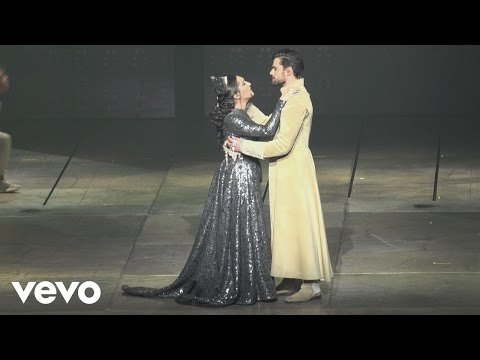
Album: spectacle musical

Same Singer
Related Songs
My Skin's On Fire
Loving Caliber
Don't You Wanna Stay
Loving Caliber

Those Eyes
New West

We Don't Talk Anymore
Charlie Puth, Selena Gomez

Monster
Shawn Mendes, Justin Bieber

Never Be the Same
Camila Cabello

The 30th
Billie Eilish

Ordinary
Alex Warren

Girls Wanna Have Fun
Josh Fawaz

Gimme Dat Love
(G)I-DLE
花咲く道
ME:I
未完成婚姻論
超学生, マサ
しおざきわんだーらんど
M!LK, 塩﨑太智

des fleurs
Tove Lo, Stromae
WOKE UP IN TOKYO
BABYMONSTER
No Promises
Shayne Ward

No promises
Shayne Ward

DREAMERS
Jungkook, Fahad Al Kubaisi

Em Mới Là Người Yêu Anh
MIN
Attention
Charlie Puth