
Lyrics & Translation
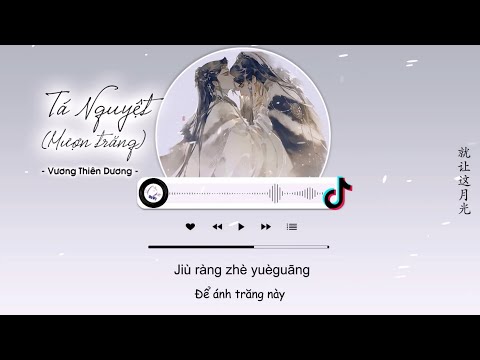
Embark on an emotional journey with Wang Tianyang's "借月" (Jie Yue), a beautiful Guofeng ballad that will enrich your understanding of Chinese lyrical expression. Through its evocative language and heartfelt message of enduring love and distant longing, you can learn common poetic phrases and cultural sentiments. The song's connection to the popular drama "Word of Honor" also makes it a special entry point into contemporary Chinese music and storytelling. Let the moonlit verses guide you to a deeper appreciation of Mandarin.
Key Vocabulary
| Vocabulary | Meanings |
|---|---|
|
告別 /gàobié/ B1 |
|
|
温柔 /wēnróu/ B2 |
|
|
志向 /zhìxiàng/ B2 |
|
|
思念 /sīniàn/ B1 |
|
|
月光 /yuèguāng/ A2 |
|
|
期待 /qīdài/ B1 |
|
|
守望 /shǒuwàng/ B2 |
|
|
離別 /líbié/ B2 |
|
|
回程 /huíchéng/ B1 |
|
|
百轉柔腸 /bǎizhuǎnróucháng/ C1 |
|
|
風光 /fēngguāng/ B2 |
|
Are there any new words in “借月” you don’t know yet?
💡 Hint: 告別, 温柔… Jump into the app and start learning now!
Key Grammar Structures
-
告別了温柔鄉
➔ Past tense with 了 (le) for completed action
➔ The particle '了' is used to indicate the completion of the action '告別' (farewell).
-
山高與水長
➔ Parallel structure with '與' (yǔ) for comparison
➔ The conjunction '與' connects two parallel elements '山高' (high mountains) and '水長' (long waters) to emphasize their coexistence.
-
但願你初心不忘
➔ Subjunctive mood with '但願' (dàn yuàn) for wish
➔ The phrase '但願' expresses a wish or hope that '你初心不忘' (you remain true to your original aspiration).
-
深情與離別遇上
➔ Use of '遇上' (yù shàng) to indicate an encounter
➔ The verb '遇上' is used to describe the encounter between '深情' (deep affection) and '離別' (parting).
-
誰懂我朝思暮想
➔ Rhetorical question with '誰懂' (shéi dǒng)
➔ The phrase '誰懂' is a rhetorical question implying that no one truly understands '我朝思暮想' (my constant thoughts).
-
就借這月光
➔ Use of '就' (jiù) for emphasis and '借' (jiè) for borrowing
➔ The particle '就' emphasizes the action '借' (borrow), referring to borrowing '這月光' (this moonlight).
-
不管落魄風光
➔ Use of '不管' (bù guǎn) for indifference or disregard
➔ The phrase '不管' indicates disregard for '落魄風光' (ups and downs in life).
-
有太多的話
➔ Use of '太多' (tài duō) for excessiveness
➔ The phrase '太多' emphasizes the excessiveness of '話' (words) that need to be said.
Same Singer
Related Songs

My Skin's On Fire
Loving Caliber

Don't You Wanna Stay
Loving Caliber

Those Eyes
New West

We Don't Talk Anymore
Charlie Puth, Selena Gomez

Monster
Shawn Mendes, Justin Bieber

Never Be the Same
Camila Cabello

The 30th
Billie Eilish

Ordinary
Alex Warren
Girls Wanna Have Fun
Josh Fawaz

Gimme Dat Love
(G)I-DLE
花咲く道
ME:I

未完成婚姻論
超学生, マサ
しおざきわんだーらんど
M!LK, 塩﨑太智

des fleurs
Tove Lo, Stromae
WOKE UP IN TOKYO
BABYMONSTER

No Promises
Shayne Ward

No promises
Shayne Ward
DREAMERS
Jungkook, Fahad Al Kubaisi

Em Mới Là Người Yêu Anh
MIN

Attention
Charlie Puth