
Es ist Abend – Letras bilingües German/Español
Letras y Traducción
Vocabulario clave
Estamos actualizando esta sección. ¡Mantente atento!
Estructuras gramaticales clave
-
Es ist Abend und wir sitzen bei mir
➔ Uso de la preposición 'bei' con dativo
➔ La preposición "bei" se usa aquí para indicar ubicación en casa de alguien, requiriendo el caso dativo.
-
Ich bin am verlier'n
➔ Progresivo renano (am + infinitivo)
➔ La construcción "am" es una forma coloquial de describir una acción continua: "Estoy perdiendo".
-
Kommst du vorbei?
➔ Verbo separable (vorbeikommen)
➔ En una pregunta, el prefijo "vorbei" se mueve al final de la oración.
-
Könntest du vielleicht
➔ Konjunktiv II (cortesía)
➔ "Könntest" es la forma Konjunktiv II de "können", usada aquí para expresar una petición cortés.
-
Glaubst du, das reicht?
➔ Oración subordinada / Pregunta indirecta
➔ La oración "das reicht" funciona como objeto del verbo "glaubst".
-
Fährst du zufällig bei Nina vorbei?
➔ Uso de adverbios (zufällig)
➔ "Zufällig" se usa como un adverbio modal que significa 'por casualidad'.
-
Ich lass einfach alles passier'n
➔ Oración de infinitivo (lassen + infinitivo)
➔ "Lass" (de lassen) lleva un infinitivo sin "zu" para expresar "dejar que algo suceda".
-
Du weißt, was ich mein
➔ Oración relativa (pronombre interrogativo como relativo)
➔ "Was" actúa como un pronombre relativo que hace referencia a toda la idea anterior.
Album: Es ist Abend und wir sitzen bei mir

Erdbeerkuchen
AnnenMayKantereit

Du tust mir nie mehr weh
AnnenMayKantereit

3 Tage am Meer
AnnenMayKantereit

Es ist Abend
AnnenMayKantereit

Katharina
AnnenMayKantereit

Orangenlied
AnnenMayKantereit
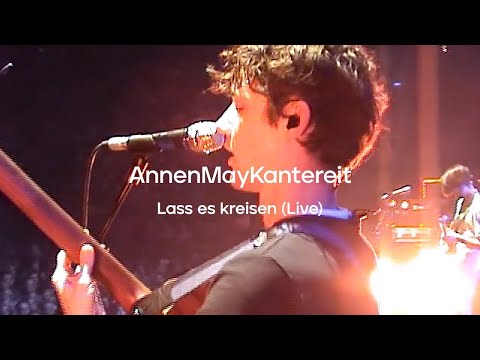
Lass es kreisen
AnnenMayKantereit
Mismo cantante
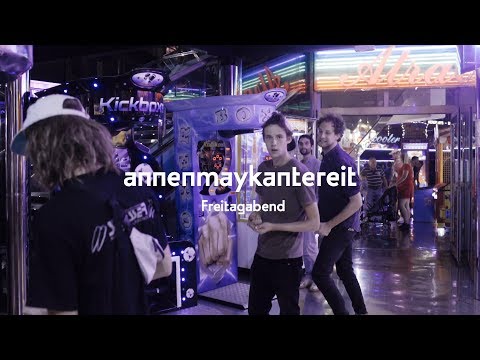
Freitagabend
AnnenMayKantereit
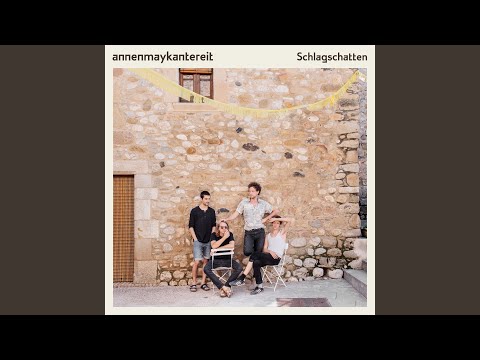
Sieben Jahre
AnnenMayKantereit
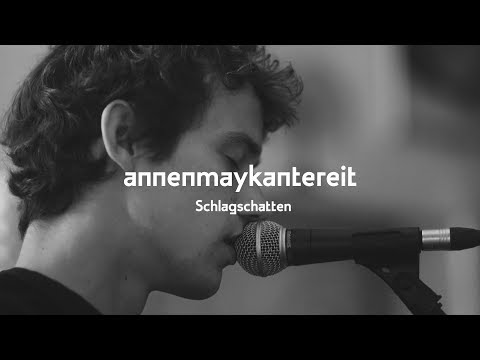
Schlagschatten
AnnenMayKantereit
3. Stock
AnnenMayKantereit
3. Stock
AnnenMayKantereit
3 Tage am Meer
AnnenMayKantereit
Es ist Abend
AnnenMayKantereit
Katharina
AnnenMayKantereit

Verliebt sein
AnnenMayKantereit
Orangenlied
AnnenMayKantereit

Intro
AnnenMayKantereit

So wies war
AnnenMayKantereit

Gegenwartsbewältigung
AnnenMayKantereit

Warte auf mich
AnnenMayKantereit

Ganz Egal
AnnenMayKantereit

Das Gefühl
AnnenMayKantereit

Die letzte Ballade
AnnenMayKantereit

Gegenwart
AnnenMayKantereit

Outro
AnnenMayKantereit
Lass es kreisen
AnnenMayKantereit
Canciones relacionadas

The Way It Is
The Strokes

I Can't Win
The Strokes

You Talk Way Too Much
The Strokes

Lemon Tang
Hearts2Hearts

Heat Waves
Glass Animals

Darling I Do
Landon Pigg, Lucy Schwartz

GROSEILLE
Timar

Mention Me
Cortis

GREENGREEN
CORTIS

Call Me Out
Loving Caliber

I Can't Find You
Loving Caliber

Wrong
Loving Caliber

Stay Here With Me
Loving Caliber, Viktor Pedersen

You Got Me Too
Loving Caliber

Plane Tickets
Loving Caliber

My Skin's On Fire
Loving Caliber

Those Eyes
New West

Sunset
Nerd Connection

なんもねえ
Wasureranneyo

REDRED
CORTIS